

This ship has sailed
Whose Party? Not Scotland's, nor much of anyone's

For my new subscribers: Welcome! This is the first article on my recently-created Substack; I have uploaded some of my “back catalogue” of writing (published and unpublished) and backdated them to reflect their original date.
On the back of my resignation as part of the Interim Scottish Executive Committee’s collective decision to resign, I thought this might be a good time to provide a tell-all account of the demise of Your Party from my somewhat “inside” perspective. In being entirely open with the thought processes that led me here, I also hope to dispel some of the lies and misapprehensions circulating among some members.
A breath of fresh air
At STUC Congress last year, I remember leaflets being handed out demanding a new party of the left. Recognising that the “Labour” Party had become anything but, suborning genocide in Gaza and continuing the devastating austerity politics of 15 years of Tory rule, the need for a new mass movement to represent the working class at every level of politics was clear.
When Jeremy Corbyn and Zarah Sultana announced “Your Party”, I and 800,000 others thought that this would be that party. A party to unify the entire progressive wing of British politics under one banner, from democratic socialists to anarchists to Leninists and anyone in between, on the basis of our common anti-capitalist ground.
I had my criticisms of Corbyn, sure – prime among them his mis-handling of the vexatious bogus accusations of anti-semitism afflicting Labour Party members under his leadership (including JVL’s Naomi Wimborne-Idrissi, who now sits on Your Party’s CEC). The success of the Starmer coup proved his ineffectiveness as Labour leader, unwilling as he was to use his position to purge the party of the destructive anti-worker neoliberal faction now in government.
But I did – naively, it turns out – believe that his heart was in the right place. That he was genuinely intent on using his public voice to rally the working class by putting the masses meaningfully at the helm of a political project for the first time since the Labour Representation Committee. That was the promise: transparent, democratic, member-led.
Social democratic centralism
Unfortunately, we were all mistaken. Corbyn has revealed himself to be only the latest iteration of the kind of “leader” that has been undermining left unity since the interwar period: so convinced is he of his own ideological “correctness” and the need to defend it against those who think differently, that the project fast turned into a high control group. That, by the way, is also the term sociologists use to describe cults.
In hindsight, this should have been clear from the outset. As information trickled in about the hitherto-unknown “Independent Alliance” he decided to band together with, it turned out some of them weren’t even working-class. Business owners and landlords have no place at the helm of a working-class party.
The wording of the political statement, ominously proposing the “broadest possible social alliance”, was the writing on the wall, and the fact that he preferred to make common cause with centrists over socialist sects (made clear by the Liverpool purges) was the nail in the coffin. Corbyn never wanted to empower the masses, he wanted an army of sycophants to return him to political relevance.
Still, despite the highly-controlled and anti-democratic nature of the Liverpool conference, the membership appeared to have won some important victories, including voting against banning dual membership. The only anti-ban option was to leave the choice of who to ban or not up to the arbitrary whims of the CEC, another omen of shenanigans to come, but at that point the outcome didn’t seem set in stone. Perhaps we would elect a CEC that wasn’t suicidal. It was in this context that preparations began for a Your Party Scotland founding conference.
A tale of false hope
The Scottish Conference Organising Group (SCOG) got off to a rocky start. Initially, we had to push back against the suggestion that we hold the conference on 10th & 11th January, when we were only constituted after the Liverpool conference at the end of November. Initially, and until they realised it would be a red line for us, HQ were very insistent on this – but why?
In hindsight, knowing their destructive and self-preserving tendencies, it seems like they were setting us up to fail for a purpose. With a month’s lead time, over Christmas and Hogmanay no less, Dundee conference would’ve been a resounding failure even compared to Liverpool.
The member input we gathered over January through surveys and online assemblies could not have happened, and everything would’ve been cobbled together in haste. This would have played right into their hands: “See, the only way to do something like this is top-down, we had no choice but to make Liverpool so regimented!” And further: “See, these grassroots activists can’t even organise a decent conference. You need our enlightened wisdom to make this thing work!”
“Do not eat the food of a begrudging host […] ‘Eat and drink,’ he says to you, but his heart is not with you.”
Proverbs 23:6-7
But they did relent, even after leaking the supposed date to the press, and so all seemed well for a brief moment. But then we started looking to engage members and reached the next hurdle: requests as simple as sending out e-mails to members were delayed by days, often more than a week, and it felt like we were deliberately being hamstrung. Yes, we still did a better job at gathering member input than Liverpool, but that’s an incredibly low bar and on the back of all the delays we ultimately did fall short of what we had intended.
Another hiccup was the notion of Your Party Scotland becoming a fully organisationally independent sister party. We were told that this was a “red line” for HQ, that we must not allow this to be debated at the Scottish Conference or they would refuse to fund it. Only by turning that brinkmanship right back on them – effectively threatening to refuse to facilitate the conference after it had already been widely publicised, in a PR catastrophe for YPUK – did we manage to avoid this.
It is worth noting here that, at that stage, SCOG members did not yet unanimously support becoming a separate sister party, but what we did unanimously support was Scottish members’ democratic right to make that decision for themselves since it had been suggested widely by grassroots members all across Scotland.
Changing my mind
In fact, for full transparency, I myself was not one of the members initially advocating for structural separation; I thought there could be strength in unity.
Nor was I even advocating for Your Party to take an explicitly pro-Scottish independence stance. I thought there was some merit in the idea of a socialist federal British Republic, and Your Party might bring that about. Members in Aberdeen and further afield can attest to this.
“Think it possible that you may be mistaken.”
Quaker Faith & Practice, 1.02(17)
My views began to shift with the shambles in Liverpool. At the Scottish fringe event on the Saturday night at Liverpool Quaker Meeting House, I was pleasantly surprised at the unity in the room. We all agreed that the conference was a shambles, and we all agreed that we could do a much better job of it ourselves, as indeed we went on to prove in Dundee. By no means did we get it perfect, but the difference from Liverpool was night and day.
That was merely the beginning. Through interacting with English and Welsh comrades from the Democratic Socialists of Your Party (DSYP), and seeing their interactions with other Scottish members, it quickly became clear to me just how divorced English socialists are from the political and material realities in Scotland.
In many cases, this was mere innocent unknowing, with those comrades (who might otherwise not have much opportunity to interact with Scots) showing a genuine curiosity and appreciation. Unfortunately, I did also have, and witness, interactions with English comrades where it became clear that they saw Scotland effectively as an irrelevance, haughtily and baselessly dismissing Scottish perspectives as ignorant, naive, or nationalistic.
At the same time, interactions with Scottish members (DSYP and otherwise) changed (back) my view on the national question. It is true that I used to be a member of the SNP and then the Scottish Greens (two actively pro-independence parties) but my own views had shifted somewhat. In the post-Brexit, multipolar world we find ourselves in, I was beginning to think federalism might be a preferable solution.
What I wasn’t aware of was the class character of support for independence, and this is what convinced me to return to the solidly pro-independence fold. We cannot expect to build a mass socialist party if our stance on one of the most polarising issues in Scottish politics is going to alienate most of the working class.
In fact, far from crowding out the pro-independence “space”, with both the SNP and Scottish Greens continuing to pursue the futile “second referendum” route, there is ample room in Scottish politics for a radical pro-independence party.
Such who have erred and are deceived
Returning to the game of brinkmanship, then, I want to be clear: even at that late stage, after a month of HQ chicanery, I myself wasn’t yet fully convinced of the need for the party to separate.
I thought the appalling leadership was circumstantial rather than inherent to the party, and that it might disappear after a “proper” leadership is democratically elected to CEC. Arguments in favour of separation were compelling, but I was looking forward to the debate at conference, to hearing comrades speak for and against, and making my mind up fully on the basis of the strength of those arguments before casting my vote.
I was only determined that that debate needed to take place, and alongside the rest of SCOG I was resolute in refusing to put my name to a conference which would patronise members by taking that decision-making power away from them, to whom it rightfully belongs.
We succeeded, and the debate took place. Speakers against largely had only platitudes to offer, appealing to ideas rather than material realities, with one exception: Jim Monaghan.
It was Jim who predicted what was now happening. Instead of the amicable divorce which had been directly proposed to us by Karie Murphy, we would end up with no member data and no money.
At the time, I dismissed this as fatalism, when in fact I had made a fatal mistake: taking the party’s then-unelected leadership at face value, encouraged perhaps by Zarah Sultana’s overt assurances during her conference speech that she would fight on CEC for Scottish conference decisions to be respected and implemented.
“Endure patiently the bitterness of truth, and beware not to be deceived by the sweetness of falsehood.”
Ali ibn Abi Talib
So I did vote for separation in the end. Little did I know that instead of the 24-member collective leadership Liverpool had voted for, we would get a 14-member tyranny of the majority. I was foolish to dismiss Jim’s assertions so easily, given he is part of the “inner circle”. In hindsight, this wasn’t a concern he was voicing, it was a threat; one they proceeded to make good on.
Of course, another omen had been the decision to only allocate one CEC member to Scotland, when every English region got two, and when even by raw proportionality (never mind any sort of federal principle) we should be entitled to three. I suppose my thinking was that they simply couldn’t be arsed with Scotland, and would therefore let us go easily. I was oblivious to how deeply the English colonial mindset is embedded within “Your Party”.
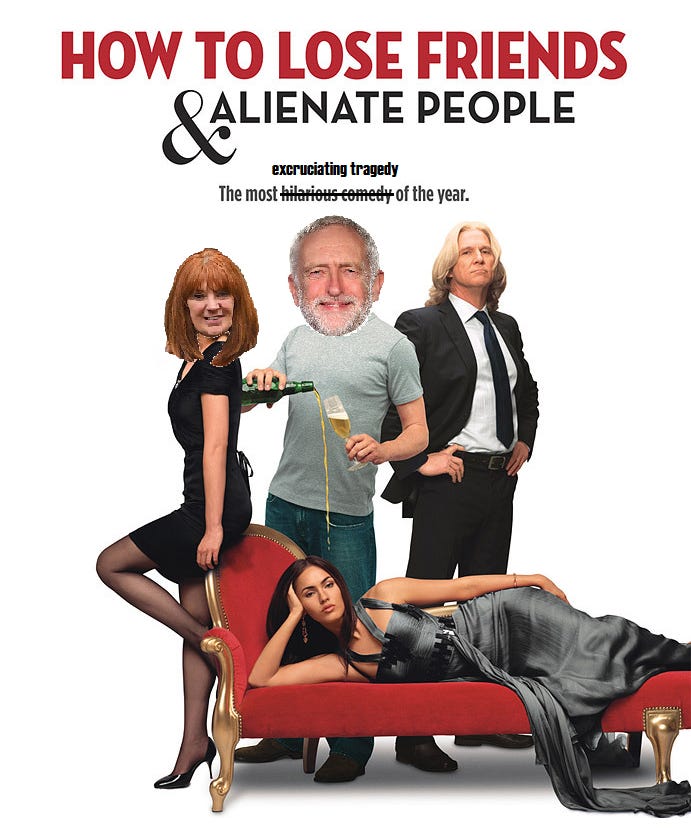
How to lose friends and alienate people
After the Dundee Conference “high”, the weeks of SCOG-HQ strife were out of sight, out of mind. We had done it – and with the backing of HQ, no less! We thought that the work could now begin in earnest: holding a ballot for an Election Organising Committee, Interim Policy Committee, and a full Scottish Executive Committee.
We separated into subgroups, ensuring that ISEC members intending to stand for SEC would not be responsible for the SEC elections, and likewise for Holyrood. We jumped right in, came up with timelines and plans, drafting emails and procedures. A mere 8 days after the founding documents were ratified, we sent off the first request to HQ.
And then? Nothing. Zilch. Radio silence. Emails, phone calls, text messages, all went unanswered. We were ghosted. Until at the start of the following week, the ISEC member who had taken up employment with HQ intimated to us that they wouldn’t lift a finger until CEC – not elected yet – “ratified” our conference decisions.
Excuse me?! So much for a member-led party! Scottish members had taken democratic decisions, they were to be implemented, no ifs, ands or buts. It’s not up to a body of 22 English people, a Welshwoman and one single Scot to decide whether our democratic decisions are good enough for them!
This marked the inflection point for me. I was tempted to resign from both ISEC and Your Party on the spot. But if there’s one thing I hate, it’s virtue signalling, so I thought the better of it: just as we had had to fight with HQ to make Dundee Conference happen, perhaps we could stay and fight and win again.
Of course, things only got worse from there. At the first CEC meeting at the beginning of March, Scotland wasn’t discussed at all, further delaying the matter when the Holyrood selection deadline (1st April) was fast approaching. I won’t rehash the goings-on at CEC meetings here as they have been thoroughly reported on by the (now-former) Scottish CEC rep, Niall Christie, and others.
The Holyrood charade
Then, with barely over a week to go until the candidate registration deadline, Karie Murphy sent an individual ISEC member a proposal for how Your Party could still stand candidates for Holyrood, asking her not to share this even with other ISEC members as this was “only a draft” and a fuller version would follow.
By the time the rest of ISEC did have sight of it, we were appalled; this “draft” was an uncoordinated shambles which had nothing to do with the Electoral Strategy members had voted for, and made ridiculous demands such as barring Your Party Scotland candidates from expressing a view on Scottish independence (which conference had explicitly backed).
It was somewhat of a foregone conclusion that Karie’s proposal would come to naught, given the online regional assemblies we had held all agreed that it was now far too late to hold anything resembling a democratic selections process.
The Officers’ Group then issued a statement following the next CEC meeting claiming that we hadn’t engaged with the proposal. The proposal explicitly included a meeting to be scheduled by the Officers’ Group with two representatives from ISEC, which they never did, so this accusation is a blatant shameless lie.
Instead, they reran the vote, once again deciding it was in their gift to override Scottish member democracy. The fact that this vote overturned the Dundee decision was entirely to be expected, given the regional assemblies had been telling us the same thing.
The pretense of democratically legitimising a “decision” which HQ through inaction and then CEC through deliberate obstruction had forced Scottish members into was nothing short of farcical, as is the party’s portrayal of our resignation being a result of us “disagreeing with the outcome of that vote”, as opposed to the relentless chicanery and abuse we have been victims to for the past two months.
We’ll dig a trench along the border
I again contemplated resigning on the spot, once again thought the better of it, and at the following ISEC meeting we all agreed that Your Party Scotland was dead. But some members still thought we hadn’t done enough to pressure London into giving us access to – not ownership of – our member data. So we did.
Meanwhile, individual members were resigning in droves, a phenomenon not unique to Scotland, and grassroots calls for us to quit YP and start something new grew louder and louder. This culminated in last night’s national assembly where there was overwhelming consensus that we should quit this failed project while we’re ahead and get on with the work of building an actual member-led democratic party of the Scottish working class.
Easier said than done, of course, but I think I speak for all those who want to organise and grow when I say that we’re up to the challenge.
To those who aren’t leaving with us, truly, best of luck to you. If and when we start something new, the doors will be open, and unlike YP we have no intention of banning dual membership, so you’re more than welcome to keep your feet in both parties – as long as YP doesn’t find out, I suppose.
PS: a note on GDPR
A persistent theme of practically everything to do with Your Party has been the fact that its leadership, both staff and CEC, clearly have absolutely no understanding of GDPR whatsoever.
The former staffer who used to be on ISEC has now publicly asserted that we attempted to “illegally gather member data” when we tried to create a mailing list, so I feel it incumbent to refute the points that lead him to this (false and libellous) conclusion:
Unincorporated associations, like ISEC or your granny’s bowling club, can be data controllers. There is absolutely no requirement that a data controller has to be an individual or a corporation. Otherwise your granny’s bowling club would be breaking the law every time they elect a new Secretary and hand over the mailing list without getting everyone’s consent for a “data transfer” first.
Registration with the ICO is only required for data controllers who are either engaged in commercial activity, or who operate CCTV. ISEC has at no point engaged in (nor even planned to do) either of those things.
There is no requirement for data controllers to have a written and published privacy policy, as indeed most small community groups and clubs don’t. What is required is that data subjects are made aware of what purposes the data will be used for, who controls it, and how to get in touch if they want to access or delete the data. All of this information was included in the required consent field on the mailing list signup form.
ISEC has at no point collected (nor tried to collect) “special category” data. Special category data does include “political opinion”, but nowhere on the mailing list signup form did we state that the mailing list was only for Your Party members, nor even only for people who broadly agree with Your Party’s political stance. Journalists for example would have been perfectly free to sign up to the list, as would literally anyone else. All we attempted to collect were names and email addressed, neither of which constitute “special category” data.
Fred: This is a good read. ++++ Love the phrase: "social democratic centralism" ++++ And love the "honesty" --- for want of a better word --- of how you have approached this "excruciating tragedy" for ALL of us. Been some tough choices. ++++ You have made a good critique of Corbynism that we all need to deepen. +++ If there is one thing the YP tops hate it is the YP grass roots getting organised ... and that's what you Scots have been doing. No surprise "mere" branches in England and Wales also been treated so badly. +++ Cheers Alan
Thanks for sending Fred. Will read in the a.m Alan